
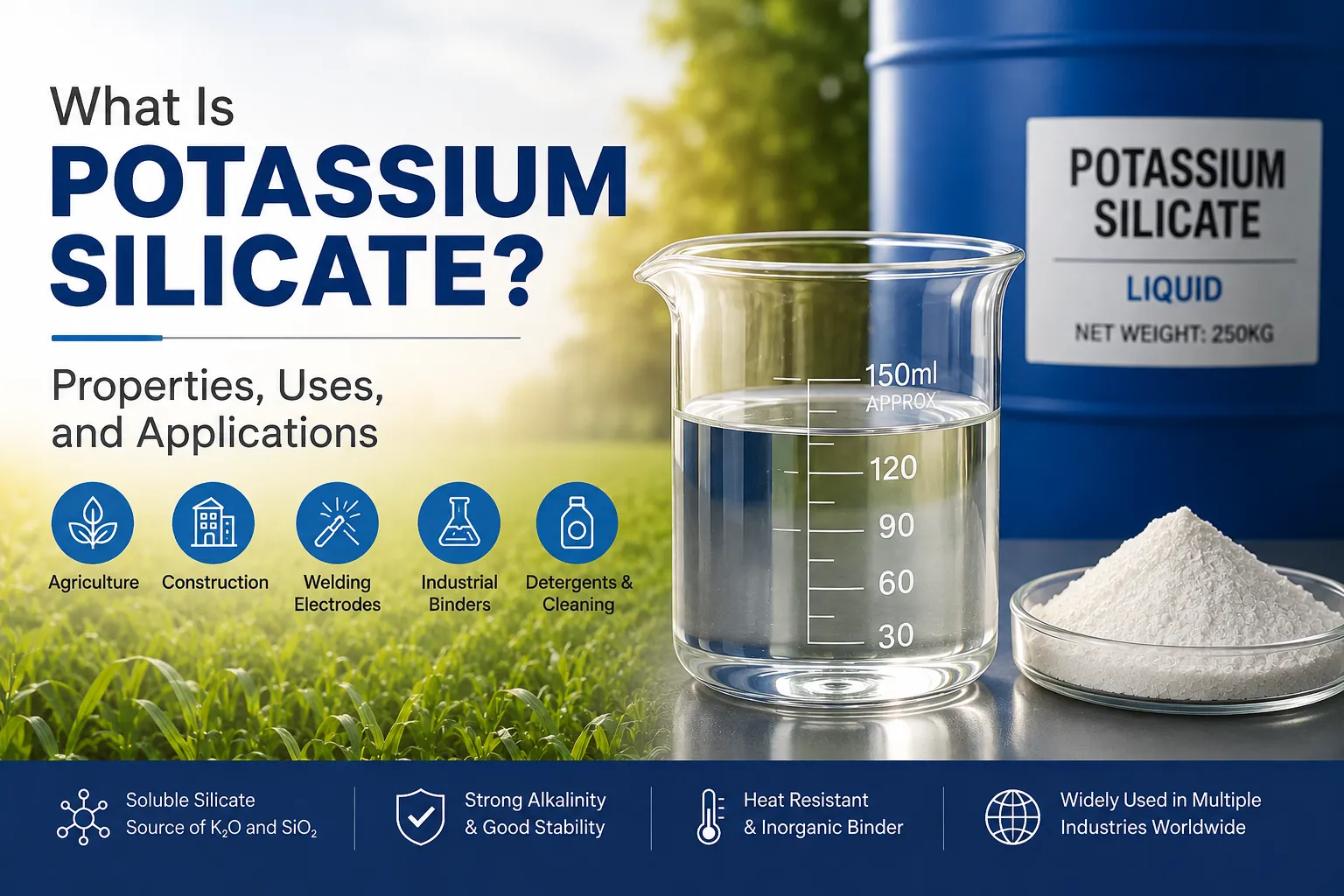
Potassium silicate is an inorganic chemical compound made primarily from silica (SiO₂) and potassium oxide (K₂O). It is commonly supplied as a clear or slightly hazy liquid, although solid forms are also available. Because of its alkalinity, water solubility, binding properties, and resistance to high temperatures, potassium silicate is widely used in agriculture, construction, welding electrodes, detergents, and industrial applications.
What Is Potassium Silicate?
Potassium silicate is a family of soluble silicate compounds containing potassium and silica. Its general chemical composition can be expressed as potassium silicate, with the ratio between SiO₂ and K₂O commonly referred to as the molar ratio or modulus.
Unlike ordinary potassium salts, potassium silicate combines the functions of a potassium source and a soluble silicate source. This makes it useful in applications where both potassium and silica are required.
Commercial potassium silicate is generally available in liquid, powder, or solid forms. The liquid form is particularly convenient for agricultural formulations, coatings, and industrial processes.
Chemical Formula of Potassium Silicate
Potassium silicate does not have only one fixed molecular composition because different products can have different SiO₂/K₂O ratios.
It is commonly represented by the general formula:K₂O·nSiO₂
where n represents the molar ratio between silica and potassium oxide.
For example, potassium silicate with a molar ratio of approximately 2.6 contains a higher proportion of silica relative to potassium oxide than a lower-modulus product.
The molar ratio is an important specification when selecting potassium silicate because it influences alkalinity, solubility, viscosity, and suitability for different applications.
Potassium Silicate Liquid
Liquid potassium silicate is one of the most widely used commercial forms.
A typical industrial liquid grade may contain approximately 25–30% SiO₂, 9–12% K₂O, and 35–40% total solids, although actual specifications vary by manufacturer and grade.
The liquid form is commonly supplied in drums, IBC tanks, or bulk containers. Its relatively easy handling and dilution make it suitable for applications where potassium silicate needs to be incorporated into a liquid formulation.
Main Applications of Potassium Silicate
1. Agriculture
Potassium silicate is used in agriculture as a source of soluble potassium and silicon.
Silicon-containing agricultural products are used in crop nutrition programs and can be incorporated into liquid fertilizer formulations. Potassium is an essential plant nutrient, while soluble silicon is used in various crop-management programs.
Potassium silicate may be used in:
- Liquid fertilizers
- Foliar spray formulations
- Soil applications
- Crop nutrition products
- Horticultural formulations
- Greenhouse agriculture
The appropriate concentration and application rate depend on the crop, formulation, and local agricultural requirements.
2. Construction Materials
Potassium silicate can be used in mineral-based construction products because of its inorganic and alkaline characteristics.
It may be incorporated into:
- Mineral coatings
- Silicate paints
- Concrete-related formulations
- Cementitious materials
- Protective coatings
Potassium silicate can contribute to the formation of inorganic silicate structures and is especially useful in formulations where mineral compatibility and inorganic composition are important.
3. Welding Electrodes
Potassium silicate is used as a binder in certain welding electrode formulations.
Its binding properties allow powdered raw materials to be held together during electrode manufacturing. After drying and processing, the inorganic binder contributes to the structure of the electrode coating.
This application requires controlled chemical composition and consistent viscosity because variations in the silicate can affect processing performance.
4. Industrial Binders
Potassium silicate can function as an inorganic binder in industrial processes.
It may be used in applications involving:
- Foundry materials
- Refractory products
- Mineral-based formulations
- High-temperature materials
- Ceramic-related applications
Its inorganic nature and heat-resistant characteristics make it useful where organic binders may not be suitable.
5. Detergent and Cleaning Applications
Silicates can be used in detergent and cleaning formulations because of their alkalinity and ability to support cleaning performance.
Depending on the formulation, potassium silicate may contribute to:
- Alkalinity
- Water conditioning
- Surface cleaning
- Corrosion control
- Formulation stability
The exact grade should be selected according to the detergent formulation and regulatory requirements of the target market.
Potassium Silicate vs. Sodium Silicate
Potassium silicate and sodium silicate are both soluble silicates, but they contain different alkali metals.
| Property | Potassium Silicate | Sodium Silicate |
|---|---|---|
| Main alkali | Potassium | Sodium |
| General composition | K₂O·nSiO₂ | Na₂O·nSiO₂ |
| Potassium source | Yes | No |
| Sodium source | No | Yes |
| Common applications | Agriculture, coatings, welding, binders | Detergents, construction, foundry, adhesives |
| Physical forms | Liquid, solid, powder | Liquid, solid, powder |
| Molar ratio | Important specification | Important specification |
The choice between potassium silicate and sodium silicate depends mainly on the required alkali component, application, formulation compatibility, and performance requirements.
Why Choose a Reliable Potassium Silicate Manufacturer?
For industrial buyers, consistency between batches is particularly important. A reliable supplier should be able to provide:
- Stable SiO₂ and K₂O content
- Consistent molar ratio
- Batch-to-batch quality control
- Technical documentation
- COA for shipments
- Flexible packaging options
- OEM packaging when required
- Stable production capacity
- Export experience
For applications such as agriculture, coatings, welding electrodes, and industrial binders, consistent chemical specifications can help reduce formulation adjustments and production problems.
Conclusion
Potassium silicate is a versatile inorganic silicate that combines the functions of a potassium source and soluble silica source. Its water solubility, alkalinity, binding properties, and inorganic structure make it useful across agriculture, construction, coatings, welding electrodes, detergents, and other industrial applications.
When selecting potassium silicate, the most important factors are usually SiO₂ content, K₂O content, molar ratio, total solids, physical form, and application requirements. Choosing the correct grade can help ensure better compatibility and more consistent performance in the final formulation.
Looking for potassium silicate liquid or solid for industrial or agricultural applications? Contact a professional manufacturer to request the latest TDS, COA, specifications, packaging options, and quotation.