
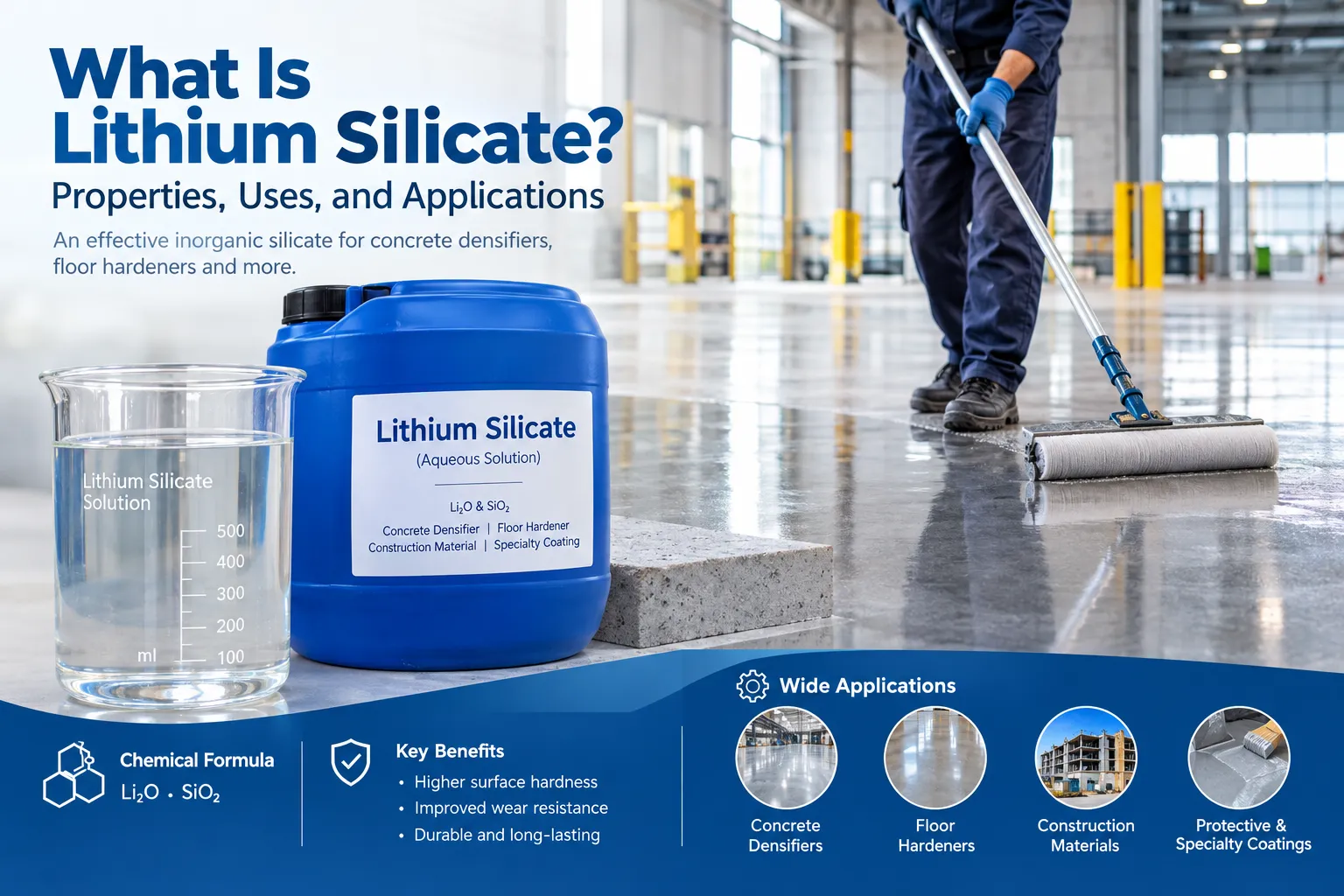
Lithium silicate is an inorganic chemical compound widely used in concrete surface treatment, construction materials, protective coatings, and specialty industrial applications. It is particularly valued for its ability to react with components in cement-based materials, helping improve surface hardness, durability, and resistance to wear.
As demand for durable and long-lasting concrete floors continues to grow, lithium silicate has become an important ingredient in modern concrete densifiers and surface hardening products.
In this article, we will explain what lithium silicate is, its chemical properties, major applications, and how to select a suitable lithium silicate product for industrial use.
1. What Is Lithium Silicate?
Lithium silicate is an inorganic silicate compound composed of lithium oxide (Li₂O) and silicon dioxide (SiO₂). It is commonly supplied as an aqueous solution for industrial applications.
Lithium silicate solutions contain soluble silicate species that can react with calcium hydroxide in cement-based materials. This reaction produces additional calcium silicate hydrate (C-S-H), a binding phase that contributes to the strength and density of concrete.
Lithium silicate is commonly used in concrete densifiers, floor hardeners, and specialty silicate formulations.
Basic information about lithium silicate:
- Product name: Lithium Silicate
- Chemical components: Lithium oxide (Li₂O) and silicon dioxide (SiO₂)
- Chemical type: Inorganic silicate
- Common form: Aqueous liquid solution
- Main applications: Concrete densification, floor hardening, construction materials, and specialty coatings
The exact composition and properties depend on the product grade, silica-to-lithia ratio, solids content, and manufacturing process.
2. Chemical Properties of Lithium Silicate
Lithium silicate offers several properties that make it suitable for concrete treatment and other industrial applications.
2.1 Reactivity with Cement-Based Materials
When applied to suitable concrete surfaces, lithium silicate can react with calcium hydroxide within the cement matrix. The resulting reaction products help fill and densify the concrete’s surface structure.
This process can improve surface hardness and abrasion resistance when the product is correctly formulated and applied.
2.2 Water-Based Formulation
Many commercial lithium silicate products are supplied as water-based solutions. These formulations can be applied to concrete surfaces using spraying, rolling, or other application methods specified by the manufacturer.
2.3 Low Residue Potential
Compared with some sodium silicate treatments, properly formulated lithium silicate densifiers can have a lower tendency to leave visible white deposits or efflorescence under suitable application conditions.
Actual performance depends on the formulation, concrete condition, application rate, and curing process.
2.4 Compatibility with Industrial Formulations
Lithium silicate can be incorporated into selected construction and coating formulations. Compatibility testing is recommended before combining it with other chemicals, additives, or binders.
3. What Is Lithium Silicate Used For?
Lithium silicate has several important industrial applications, particularly in concrete treatment and construction materials.
3.1 Concrete Densifiers and Floor Hardeners
One of the major applications of lithium silicate is in concrete densifiers.
When applied to properly prepared concrete, lithium silicate reacts with calcium hydroxide to form additional calcium silicate hydrate. This helps densify the surface and improve resistance to abrasion.
Typical applications include:
- Industrial warehouse floors
- Factory floors
- Commercial buildings
- Shopping centers
- Parking garages
- Polished concrete floors
- Logistics and distribution centers
Lithium silicate densifiers are often selected for projects requiring durable concrete surfaces and a clean finished appearance.
3.2 Concrete Polishing
Lithium silicate is frequently used in polished concrete flooring systems. It can help harden the concrete surface before or during the polishing process, depending on the specified system.
A denser surface can support a more durable polished finish and help reduce dusting associated with weak or poorly consolidated concrete surfaces.
The final result depends on concrete quality, surface preparation, grinding procedures, and the complete polishing system.
3.3 Construction Materials
Lithium silicate may be used in selected construction material formulations where silicate chemistry and surface hardening properties are required.
Potential uses include specialty concrete treatments, mineral substrates, and certain inorganic coating systems. Suitability should be confirmed through formulation and performance testing.
3.4 Protective and Specialty Coatings
Certain lithium silicate formulations are used in inorganic coating systems and mineral surface treatments. Depending on the formulation, they may provide binding, adhesion, or chemical resistance characteristics.
The performance of a finished coating depends on the substrate, other ingredients, curing conditions, and intended service environment.
4. Lithium Silicate vs. Sodium Silicate
Lithium silicate and sodium silicate are both inorganic silicates, but their cations and formulation characteristics differ. Their suitability depends on the application and required performance.
| Feature | Lithium Silicate | Sodium Silicate |
|---|---|---|
| Main cation | Lithium (Li⁺) | Sodium (Na⁺) |
| Common form | Aqueous solution | Liquid, solid, or powder |
| Concrete densification | Widely used in concrete densifiers | Also used in selected concrete treatments |
| White residue potential | Often lower in suitable formulations | May be more prone to visible deposits in some applications |
| Typical applications | Concrete densifiers, floor hardeners, specialty coatings | Detergents, foundry binders, construction, adhesives, and other industrial uses |
| Selection factors | Formulation, solids content, ratio, and performance | Modulus, concentration, viscosity, and application requirements |
Lithium silicate is often preferred for concrete densification systems where minimizing visible residue is important. Sodium silicate remains widely used across many industrial sectors because of its versatility and availability in different physical forms.
Neither product is universally better. The correct choice depends on the intended application, technical requirements, and total formulation cost.
5. How to Choose a Suitable Lithium Silicate Product
When purchasing lithium silicate for industrial use, buyers should evaluate several technical parameters.
5.1 Lithium Oxide and Silica Content
The Li₂O and SiO₂ contents influence the composition and properties of lithium silicate solutions. Buyers should request a technical data sheet (TDS) and certificate of analysis (COA) to verify the composition.
5.2 Solids Content
Solids content affects the concentration of the solution and may influence formulation requirements, handling, and application performance.
When comparing suppliers, ensure that the quoted products have comparable solids contents.
5.3 Silica-to-Lithia Ratio
The SiO₂-to-Li₂O ratio is an important compositional parameter. Different ratios may produce different solution characteristics and application performance.
Buyers should specify the required ratio or share their application requirements with the manufacturer.
5.4 Appearance and Stability
Depending on the product specification, buyers may require a clear, uniform solution with controlled viscosity and good storage stability.
Appearance alone cannot confirm product quality. Chemical analysis and application testing are also important.
5.5 Packaging and Transportation
Industrial lithium silicate solutions may be supplied in suitable plastic drums, IBC tanks, or other compatible containers, depending on the manufacturer’s packaging options and the buyer’s requirements.
Before ordering, confirm packaging specifications, net weight, shelf life, storage conditions, and international transportation requirements.
6. Frequently Asked Questions About Lithium Silicate
Is lithium silicate soluble in water?
Commercial lithium silicate products are commonly supplied as aqueous solutions. Their solubility and stability depend on composition, concentration, and formulation.
Is lithium silicate used for concrete floors?
Yes. Lithium silicate is widely used in concrete densifiers and floor hardeners. It reacts with calcium hydroxide in cement-based materials, helping densify the surface and improve abrasion resistance.
What is the difference between lithium silicate and lithium carbonate?
Lithium silicate contains lithium and silicate species, while lithium carbonate (Li₂CO₃) is a different inorganic compound containing lithium and carbonate ions. They have different chemical properties and industrial applications and should not be treated as interchangeable products.
Can lithium silicate replace sodium silicate?
Not in every application. Lithium silicate and sodium silicate have different compositions and performance characteristics. Substitution requires an evaluation of the intended use, formulation compatibility, and technical requirements.
How should lithium silicate be stored?
Follow the supplier’s safety data sheet (SDS) and product-specific storage instructions. Use compatible, tightly closed containers and protect the product from unsuitable temperatures or conditions that could affect stability.
7. Conclusion
Lithium silicate is an important inorganic chemical used in concrete densifiers, floor hardeners, polished concrete systems, and selected specialty coatings. Its reaction with calcium hydroxide helps produce additional calcium silicate hydrate, contributing to a harder and denser concrete surface.
For industrial buyers, selecting the right lithium silicate product requires evaluating chemical composition, solids content, silica-to-lithia ratio, stability, packaging, and application performance.
If you are sourcing lithium silicate for concrete treatment or other industrial applications, request the product’s technical data sheet and certificate of analysis to ensure that the specification matches your requirements.
Looking for lithium silicate for your industrial application? Contact Weifang Changs Chemical Industry Co., Ltd. to discuss your product specifications, packaging requirements, and export supply needs.Specialized supply of lithium silicate market.