
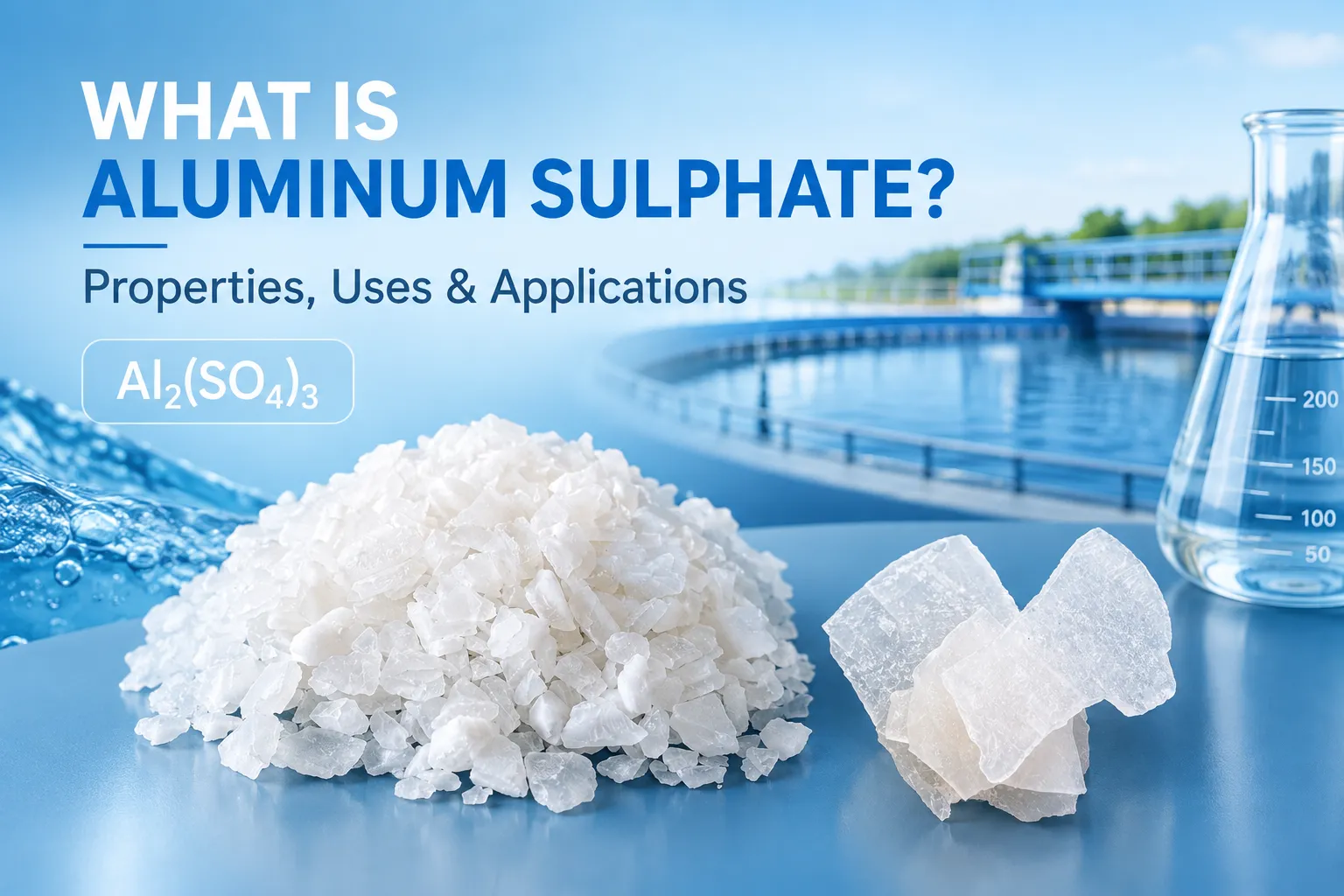
Aluminum sulphate is an inorganic chemical compound widely used in water treatment, paper manufacturing, textile processing, and several industrial applications. It is commonly supplied as a solid powder, flakes, or granular material and is valued for its ability to promote coagulation and remove suspended impurities from water.
The chemical formula of aluminum sulphate is Al₂(SO₄)₃. When dissolved in water, it produces aluminum ions that react with impurities and help form larger particles, making them easier to separate through sedimentation or filtration.
What Is Aluminum Sulphate?
Aluminum sulphate, also spelled aluminum sulfate, is an inorganic salt composed of aluminum, sulfur, and oxygen.
Its chemical formula is:
Al₂(SO₄)₃
Commercial aluminum sulphate can be supplied in different physical forms and specifications depending on the intended application. It is commonly used as a coagulant in water treatment and as a process chemical in paper production.
In water treatment, aluminum sulphate reacts with water to form aluminum hydroxide flocs. These flocs can capture suspended solids, colloidal particles, and other impurities, allowing them to be removed more efficiently.
Aluminum Sulphate Chemical Formula
The chemical formula of aluminum sulphate is Al₂(SO₄)₃.
Its main components are:
- Aluminum (Al)
- Sulfur (S)
- Oxygen (O)
When aluminum sulphate is added to water, it undergoes hydrolysis and contributes to the formation of aluminum hydroxide, which acts as a floc-forming material.
The simplified reaction can be represented as:
Al₂(SO₄)₃ + 6H₂O → 2Al(OH)₃ + 3H₂SO₄
The actual chemistry in a water-treatment system depends on factors such as pH, alkalinity, dosage, temperature, and water composition.
What Is Aluminum Sulphate Used For?
Aluminum sulphate has several important industrial applications.
1. Water Treatment
One of the largest applications of aluminum sulphate is water and wastewater treatment.
It is used as a coagulant to help remove:
- Suspended solids
- Colloidal particles
- Turbidity
- Organic matter
- Certain phosphorus compounds
- Some color-causing substances
When aluminum sulphate is added to water, it helps destabilize small particles. These particles can then combine into larger flocs that can be separated by sedimentation or filtration.
This makes aluminum sulphate useful for:
- Drinking water treatment
- Industrial wastewater treatment
- Municipal wastewater treatment
- Surface water treatment
- Process water treatment
2. Paper Manufacturing
Aluminum sulphate is also used in the paper industry.
It can be used as a process chemical to help control the interaction between fibers, fillers, sizing agents, and other components during paper production.
Depending on the papermaking process, aluminum sulphate can contribute to:
- Sizing control
- Retention
- Improved paper formation
- Process chemistry adjustment
Its use and dosage depend on the paper grade and production process.
3. Textile Industry
Aluminum sulphate can be used in certain textile processing and dyeing applications.
It can function as a processing or fixing agent depending on the specific dye system and production conditions.
4. Industrial Applications
Aluminum sulphate is also used in various other industrial processes where its coagulation, acidity, or aluminum-ion chemistry is useful.
The appropriate grade and specification should be selected according to the final application.
How Does Aluminum Sulphate Work in Water Treatment?
The main function of aluminum sulphate in water treatment is coagulation.
Many suspended particles in water are extremely small and may remain dispersed for a long time. Because of their surface charge and small size, they are difficult to remove through simple settling.
When aluminum sulphate is added, aluminum species are generated in the water. Under suitable pH and alkalinity conditions, these species contribute to the formation of aluminum hydroxide flocs.
The basic treatment process can be described as:
Aluminum Sulphate → Hydrolysis → Floc Formation → Particle Capture → Sedimentation/Filtration
The resulting flocs can capture smaller suspended particles and help bring them together into larger aggregates.
Aluminum Sulphate vs. PAC
Aluminum sulphate and polyaluminum chloride (PAC) are both widely used aluminum-based coagulants, but they have different characteristics.
| Feature | Aluminum Sulphate | PAC |
|---|---|---|
| Main component | Aluminum sulphate | Polyaluminum chloride |
| Chemical formula | Al₂(SO₄)₃ | Alₙ(OH)ₘCl₍₃ₙ₋ₘ₎ |
| Main application | Water treatment | Water treatment |
| Physical forms | Powder, flakes, granules | Powder or liquid |
| Coagulation mechanism | Aluminum hydrolysis and floc formation | Pre-polymerized aluminum species |
| pH impact | Can consume alkalinity and reduce pH | Generally lower alkalinity consumption |
| Application | Municipal and industrial water treatment | Municipal and industrial water treatment |
The choice between aluminum sulphate and PAC depends on the raw water characteristics, treatment process, required dosage, pH, alkalinity, and operating conditions.
How to Choose Aluminum Sulphate?
When purchasing aluminum sulphate for industrial use, buyers should consider several factors.
1. Application
First determine whether the product will be used for:
- Drinking water treatment
- Industrial wastewater
- Municipal wastewater
- Paper production
- Textile processing
- Other industrial applications
Different applications may require different specifications.
2. Aluminum Oxide Content
The available Al₂O₃ content is an important specification for water-treatment grades. Buyers should compare products based on the actual specification and testing method provided by the supplier.
3. Iron Content
Depending on the application, iron content can be an important consideration. For applications where product color or water quality is critical, low-iron aluminum sulphate may be preferred.
4. Water-Insoluble Matter
Low water-insoluble matter can be important for applications requiring cleaner dissolution and consistent treatment performance.
5. Packaging
Common industrial packaging options include:
- 25 kg bags
- 500 kg bags
- 1,000 kg jumbo bags
- Customized packaging
Packaging can be selected according to transportation, storage, and dosing requirements.
Aluminum Sulphate Storage
Aluminum sulphate should be stored in a dry and well-ventilated warehouse.
The product should be protected from:
- Moisture
- Rain
- Direct contact with water
- Contamination from incompatible materials
Because aluminum sulphate can absorb moisture, proper packaging and storage conditions are important for maintaining its physical condition during transportation and storage.
Aluminum Sulphate Manufacturer and Supplier
For industrial buyers, selecting a reliable aluminum sulphate supplier involves more than comparing price.
Important factors include:
- Product specification
- Production capacity
- Quality control
- Batch consistency
- Packaging options
- Lead time
- Export experience
- Technical documentation
- Loading and logistics capability
For large-volume water-treatment projects, buyers should also request a COA (Certificate of Analysis) and confirm the required technical specification before placing an order.
Frequently Asked Questions
Is aluminum sulphate the same as aluminum sulfate?
Yes. Aluminum sulphate and aluminum sulfate refer to the same chemical compound, Al₂(SO₄)₃. “Sulphate” is commonly used in British English, while “sulfate” is commonly used in American English.
What is the main use of aluminum sulphate?
Its major industrial use is as a coagulant in water and wastewater treatment. It is also used in paper manufacturing and other industrial processes.
What is the chemical formula of aluminum sulphate?
The chemical formula is Al₂(SO₄)₃.
Is aluminum sulphate used in drinking water treatment?
Yes. Aluminum sulphate is widely used as a coagulant in drinking water treatment. Its dosage should be determined according to raw water quality and treatment conditions.
What is the difference between aluminum sulphate and PAC?
Both are aluminum-based coagulants, but their chemical structures and coagulation characteristics are different. PAC contains polymerized aluminum species, while aluminum sulphate relies on hydrolysis and subsequent floc formation.
What factors affect aluminum sulphate performance?
Important factors include pH, alkalinity, water temperature, turbidity, organic matter, dosage, and the characteristics of the raw water. Jar testing is commonly used to determine an appropriate coagulant dosage.
Conclusion
Weifang Changs Chemical Industry Co., Ltd. is a professional supplier of Aluminum Sulphate, offering granules, powder, and flakes for water treatment and various industrial applications.
Aluminum sulphate is an important inorganic chemical with applications across water treatment, wastewater treatment, paper manufacturing, textile processing, and other industrial processes.
Its chemical formula is Al₂(SO₄)₃, and its ability to promote coagulation makes it particularly useful for removing suspended and colloidal impurities from water.
For industrial procurement, buyers should select aluminum sulphate according to the required application, Al₂O₃ content, iron content, insoluble matter, physical form, packaging, and applicable quality requirements.