
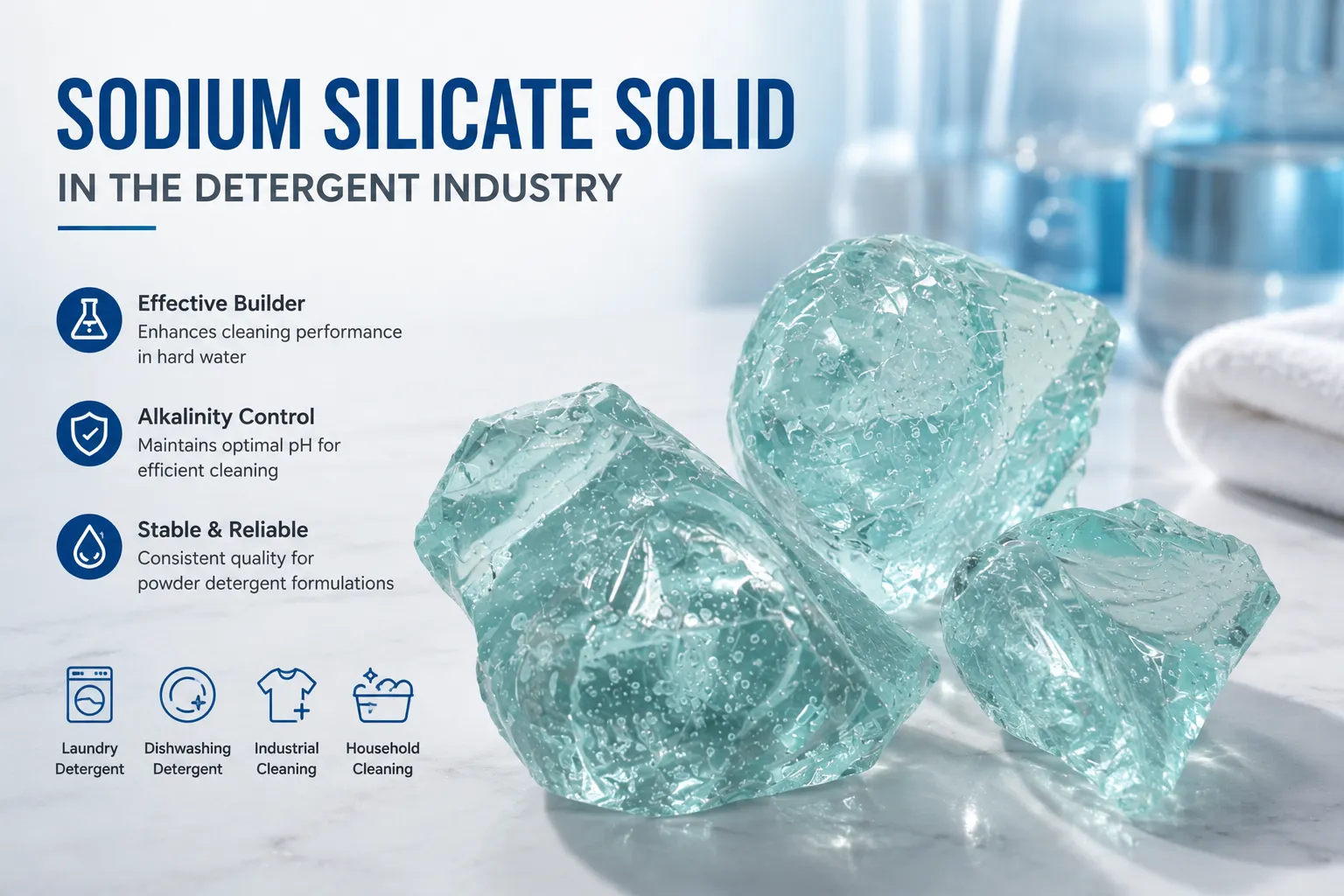
Sodium silicate solid is an important inorganic chemical widely used in the detergent and cleaning products industry. It is commonly used as a builder, alkalinity regulator, water softener, and processing aid in powder detergents and other cleaning formulations.
Because of its chemical stability, alkalinity, and compatibility with other detergent ingredients, sodium silicate solid can help improve cleaning performance while supporting the stability of the finished detergent.
What Is Sodium Silicate Solid?
Sodium silicate solid is an inorganic compound produced from silica and sodium-containing raw materials. It is commonly supplied in solid, granular, or glass-like forms and is available in different SiO₂/Na₂O molar ratios, depending on the intended application.
The molar ratio is an important parameter because it affects the alkalinity, solubility, and behavior of sodium silicate in detergent formulations.
In the detergent industry, manufacturers normally select a suitable sodium silicate grade according to:
- SiO₂/Na₂O molar ratio
- Solubility requirements
- Alkalinity
- Particle size
- Moisture content
- Compatibility with other detergent ingredients
- Production process and formulation
Why Is Sodium Silicate Solid Used in Detergents?
Sodium silicate solid performs several useful functions in detergent formulations. It is especially suitable for powder detergents because its solid form can be incorporated directly into dry formulations.
1. Water Softening
Hard water contains calcium and magnesium ions that can reduce the effectiveness of cleaning agents.
Sodium silicate can help control the effects of hardness ions and reduce their negative influence during washing. This makes it useful as part of a detergent builder system.
By helping manage water hardness, sodium silicate can support better interaction between the detergent and the soil on fabrics.
2. Provides Alkalinity
Sodium silicate is an alkaline inorganic material. In detergent formulations, it can contribute to the required alkaline environment during washing.
An appropriate alkaline environment can help detergents remove common soils such as grease, oil, and other organic residues.
The alkalinity of sodium silicate depends partly on its molar ratio and formulation, so detergent manufacturers need to select a grade that matches their formulation requirements.
3. Supports Cleaning Performance
Sodium silicate can work together with surfactants, builders, and other detergent ingredients.
Its role in controlling water hardness and maintaining alkalinity can help the overall detergent system perform more effectively during washing.
For this reason, sodium silicate solid is often used in formulations where stable cleaning performance is required.
4. Helps Protect Washing Equipment
Sodium silicate can also provide a degree of protection for metal surfaces under suitable formulation conditions.
This characteristic is useful in laundry detergents because washing equipment contains metal components that may be exposed to alkaline cleaning solutions and water during repeated washing cycles.
The exact corrosion-control performance depends on the complete detergent formulation, concentration, water quality, and washing conditions.
5. Improves Powder Detergent Formulation
Solid sodium silicate is convenient for dry detergent production.
It can be blended with other powdered raw materials during the manufacturing process. Depending on the production method, it can contribute to the structure and physical properties of the detergent powder.
This makes sodium silicate solid a practical ingredient for manufacturers producing powdered laundry detergents and industrial cleaning powders.
Sodium Silicate Solid in Powder Detergent
owder detergent is one of the major applications of sodium silicate solid.
A typical detergent formulation may contain several types of ingredients, including:
- Surfactants
- Sodium carbonate
- Sodium silicate
- Sodium sulfate
- Zeolite
- Sodium bicarbonate
- Enzymes
- Optical brighteners
- Fragrances
- Other functional additives
Each ingredient has a different role in the formulation.
Sodium silicate can complement sodium carbonate and other builders by providing alkalinity and helping manage the effects of hard water.
How to Choose Sodium Silicate Solid for Detergent Production?
When purchasing sodium silicate solid for detergent applications, manufacturers should consider more than price.
Molar Ratio:The SiO₂/Na₂O molar ratio is one of the most important specifications.
Different ratios provide different levels of alkalinity, solubility, and chemical behavior. Therefore, the required ratio should be selected according to the detergent formulation.
Solubility:Solubility is important for detergent products that need to dissolve efficiently during washing.
The actual dissolution behavior can also depend on particle size, temperature, water quality, and the other ingredients in the detergent.
Batch Stability
For detergent manufacturers purchasing large quantities, consistent chemical specifications between batches are important.
A reliable supplier should be able to provide consistent molar ratio, SiO₂ content, Na₂O content, moisture, and other agreed specifications.
Conclusion
Sodium silicate solid is an important functional raw material in the detergent industry. It can provide alkalinity, help manage hard water, support cleaning performance, and contribute to the protection of metal surfaces.
For powder detergent manufacturers, selecting the correct sodium silicate grade is important. Key factors such as SiO₂/Na₂O molar ratio, solubility, particle size, moisture content, and batch consistency should be evaluated before purchasing.
By selecting the right sodium silicate solid grade and maintaining a stable supply, detergent manufacturers can develop more consistent and efficient cleaning formulations.