
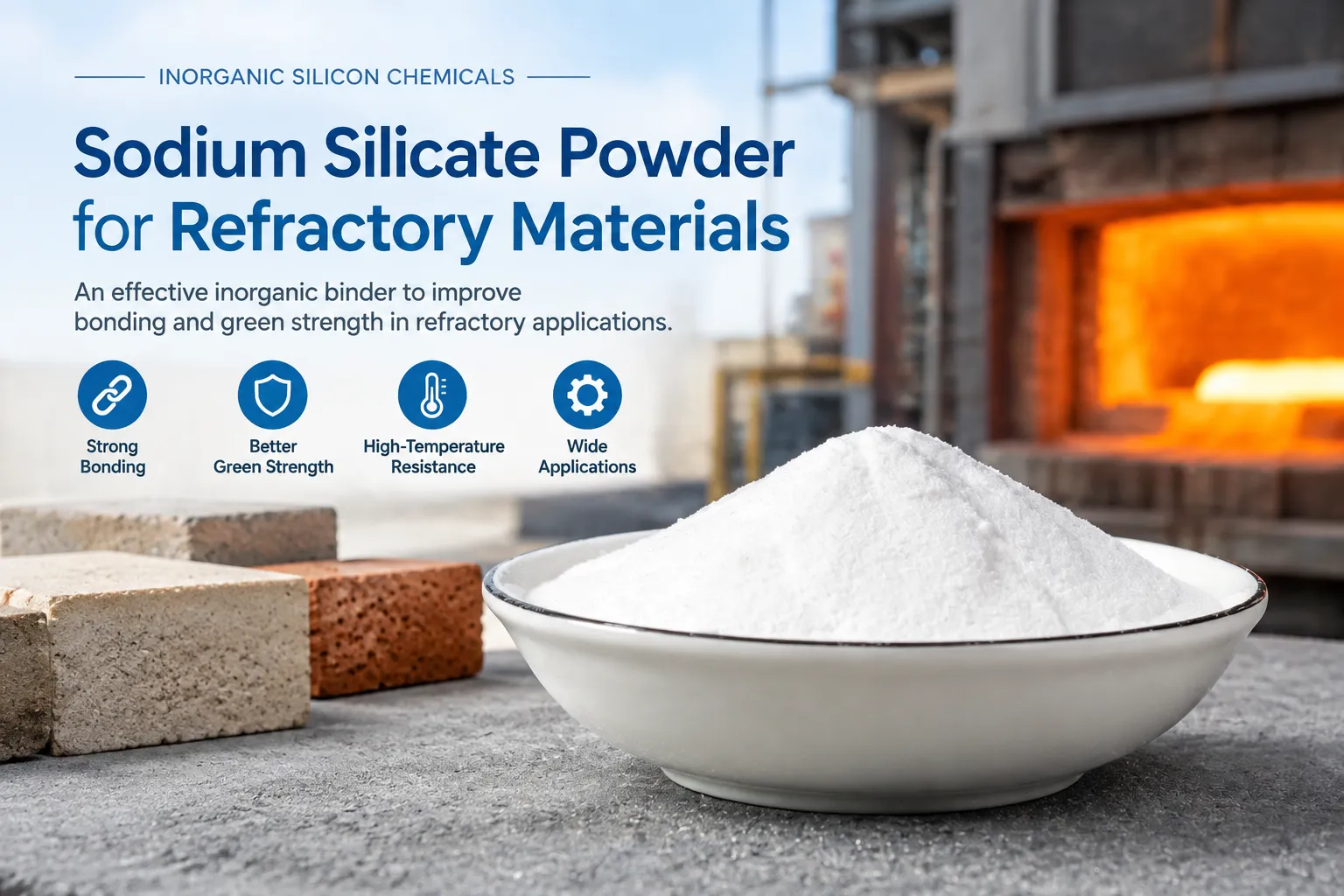
Sodium silicate powder is an inorganic silicate material widely used in industrial applications. Because of its bonding properties, alkaline characteristics, and ability to form a strong inorganic binder, it can be used in the production of refractory materials and refractory mixtures.
In refractory applications, sodium silicate powder can help improve the bonding performance of mixtures and contribute to the strength and structural stability of formed materials. It is particularly useful where an inorganic binder is preferred.
What Is Sodium Silicate Powder?
Sodium silicate powder is a solid form of sodium silicate, an inorganic compound generally composed of sodium oxide (Na₂O) and silicon dioxide (SiO₂).
The properties of sodium silicate depend strongly on its chemical composition and SiO₂/Na₂O ratio, commonly referred to as the modulus.
Compared with liquid sodium silicate, sodium silicate powder is easier to store, transport, and incorporate into dry formulations. This makes it suitable for industrial processes where a dry inorganic binder is required.
Why Is Sodium Silicate Powder Used in Refractory Materials?
Refractory materials are designed to withstand high temperatures and demanding industrial conditions. Their performance depends not only on the refractory raw materials but also on the binder system used during forming and processing.
Sodium silicate powder can serve as an inorganic binder in certain refractory formulations.
1. Inorganic Bonding
Sodium silicate forms an inorganic bonding system that can help bind refractory particles together.
This is useful in applications where manufacturers need to improve the green strength or handling strength of a refractory mixture before further processing.
2. Improved Green Strength
When properly formulated, sodium silicate can increase the initial strength of refractory mixtures.
Improved green strength helps the formed material maintain its shape during handling, transportation, drying, and subsequent processing.
3. Easy Incorporation into Dry Mixtures
Sodium silicate powder can be directly incorporated into dry refractory formulations.
Compared with liquid binders, the powder form can simplify the handling of dry raw materials and help manufacturers prepare premixed formulations with controlled binder content.
4. Good Compatibility with Inorganic Systems
Sodium silicate is an inorganic material and can be used with various mineral and refractory raw materials.
The actual compatibility depends on the refractory composition, processing temperature, binder dosage, and required final properties.
How Sodium Silicate Powder Works as a Refractory Binder
The basic function of sodium silicate powder in a refractory mixture is to provide an inorganic bonding component.
During processing, sodium silicate interacts with moisture and the surrounding mineral components. Depending on the formulation and curing conditions, it can develop bonding strength between particles.
A typical process can be summarized as:
Refractory Raw Materials → Sodium Silicate Powder Addition → Mixing → Forming → Curing/Drying → Refractory Product
The final performance depends on several factors, including:
- Sodium silicate modulus
- Na₂O and SiO₂ content
- Binder dosage
- Particle size
- Moisture content
- Mixing conditions
- Curing or drying conditions
- Type of refractory raw material
Therefore, the appropriate sodium silicate grade should be selected according to the specific refractory formulation.
Applications of Sodium Silicate Powder in Refractory Materials
Sodium silicate powder can be considered for various refractory-related formulations and industrial products, including:
Refractory Castables
In selected castable formulations, inorganic binders can be used to improve the bonding and forming characteristics of the mixture.
The appropriate binder system depends on the raw materials and the required service temperature.
Refractory Mortars
Sodium silicate-based binders may be used in certain refractory mortar formulations to provide bonding between refractory particles and surfaces.
Refractory Coatings
Sodium silicate can also be used as an inorganic binder in some refractory and heat-resistant coating formulations.
The binder helps the coating adhere to the substrate and maintain its structure during processing.
Furnace and Kiln Applications
Refractory materials are widely used in furnaces, kilns, foundries, and other high-temperature industrial equipment.
Sodium silicate powder can be used as part of selected refractory formulations designed for these industrial environments.
Sodium Silicate Powder vs. Liquid Sodium Silicate
Both powder and liquid sodium silicate can function as inorganic binders, but their handling characteristics are different.
| Feature | Sodium Silicate Powder | Sodium Silicate Liquid |
|---|---|---|
| Physical form | Dry powder | Liquid |
| Storage | Easy to store as a dry material | Requires suitable liquid storage |
| Transportation | Convenient for dry formulations | Bulk or drum transportation |
| Mixing | Suitable for dry premixes | Added as a liquid binder |
| Water content | Low | Contains water |
| Application | Dry refractory formulations | Wet mixing and liquid-binder systems |
The choice between powder and liquid sodium silicate depends on the production process and formulation requirements.
How to Select Sodium Silicate Powder for Refractory Use
Selecting the correct grade is important because sodium silicate properties can vary according to chemical composition and modulus.
Manufacturers should consider:
Modulus
The SiO₂/Na₂O ratio affects the behavior and performance of sodium silicate.
Different refractory formulations may require different modulus ranges, so the grade should be selected according to the formulation and processing conditions.
Chemical Composition
The SiO₂ and Na₂O contents should be controlled according to the customer’s technical requirements.
A consistent chemical composition helps maintain stable production performance from batch to batch.
Particle Size
Particle size can affect dispersion, mixing efficiency, and reaction behavior.
The appropriate particle size should be selected according to the mixing equipment and refractory formulation.
Moisture Content
For dry refractory mixtures, controlled moisture content is important for storage stability and accurate formulation.
Packaging
For industrial applications, sodium silicate powder can be supplied in suitable bags or customized packaging according to transportation, storage, and customer requirements.
Sodium Silicate Powder Manufacturer and Supplier
For refractory applications, stable product quality and consistent chemical specifications are important for maintaining reliable production.
Weifang Changs Chemical Industry Co., Ltd. is a manufacturer and exporter specializing in sodium silicate and other inorganic silicon chemicals.
Our sodium silicate products are available in different physical forms and specifications for industrial applications. We can provide technical specifications and packaging options according to customer requirements.
For refractory manufacturers, foundries, and industrial material producers, the appropriate sodium silicate grade can be selected based on modulus, chemical composition, physical form, and application requirements.
Conclusion
Sodium silicate powder is a useful inorganic material for selected refractory formulations. Its bonding properties, dry-powder form, and adjustable chemical characteristics make it suitable for applications such as refractory mixtures, mortars, coatings, and other inorganic material systems.
For the best results, manufacturers should evaluate the modulus, chemical composition, particle size, dosage, and processing conditions before selecting a sodium silicate powder grade.
If you are looking for sodium silicate powder for refractory materials, contact Weifang Changs Chemical Industry Co., Ltd. for product specifications and application support.