
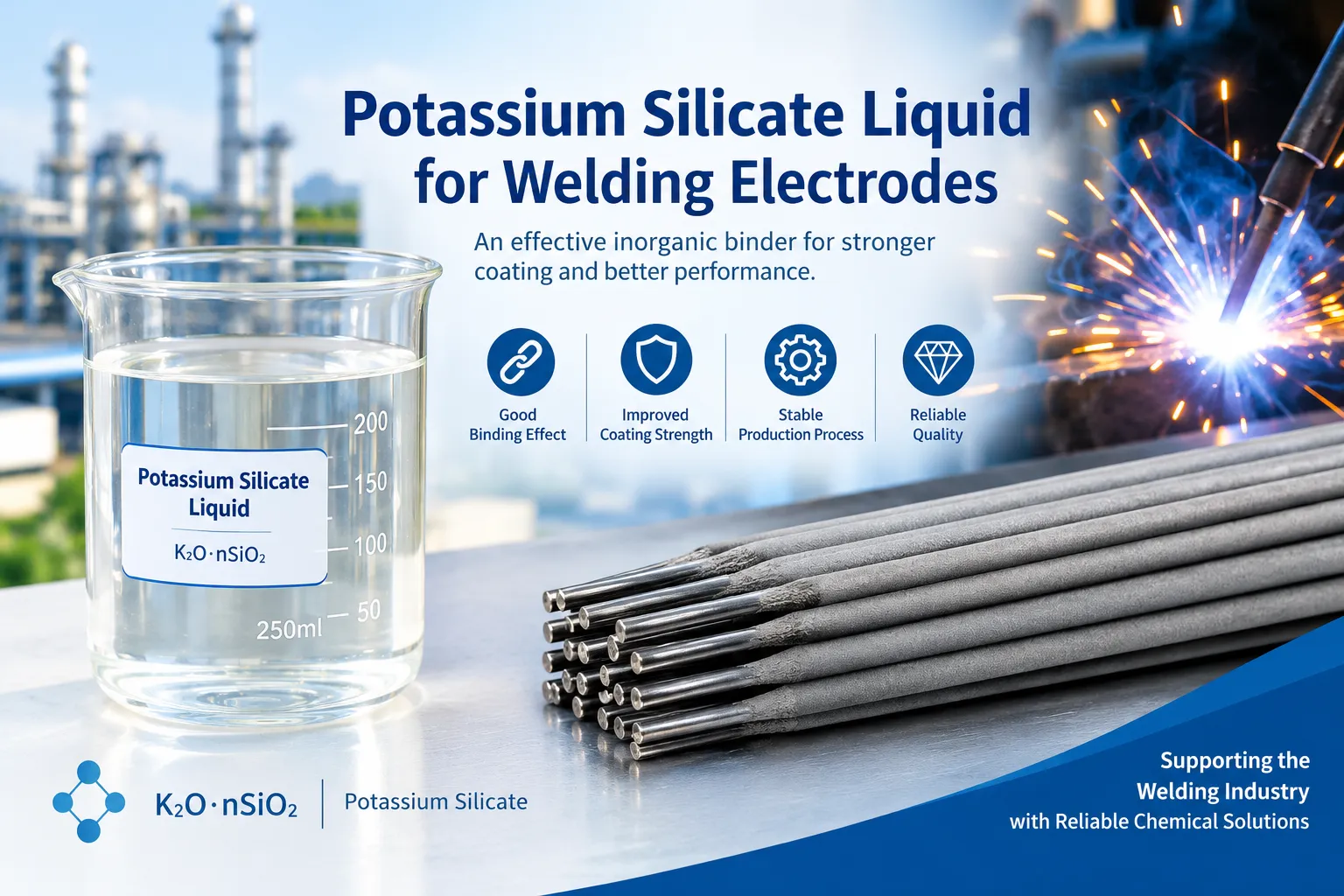
Potassium silicate liquid is an inorganic silicate solution widely used in industrial applications. One important application is the production of welding electrodes, where potassium silicate can function as a binder and contribute to the performance and stability of the electrode coating.
For welding electrode manufacturers, selecting the appropriate silicate binder is important because it can affect coating adhesion, drying behavior, mechanical strength, and the overall manufacturing process.
What Is Potassium Silicate Liquid?
Potassium silicate liquid is an aqueous solution containing potassium oxide (K₂O) and silicon dioxide (SiO₂). It is commonly represented by the chemical formula:
K₂O·nSiO₂
The ratio between SiO₂ and K₂O is generally referred to as the molar ratio or modulus.
Depending on the production process and application, potassium silicate liquid can be supplied in different concentrations and molar ratios.
Typical technical parameters may include:
- SiO₂ content
- K₂O content
- Total solids
- Molar ratio
- Density
- Viscosity
- Appearance
- pH
For welding electrode production, the appropriate specification should be selected according to the electrode formulation and coating process.
Why Is Potassium Silicate Used in Welding Electrodes?
Welding electrode coatings contain various mineral and inorganic components. A binder is required to hold these components together and form a uniform coating around the metal core.
Potassium silicate liquid can be used as an inorganic binder in electrode manufacturing.
Its main functions include:
1. Binding the Coating Ingredients
Potassium silicate helps bind powdered raw materials together during electrode coating.
It can improve the cohesion of the coating mixture and help the coating adhere to the electrode core.
2. Improving Green Coating Strength
After coating, the electrode needs sufficient mechanical strength before final drying or baking.
Potassium silicate can contribute to the strength of the uncured coating, helping reduce problems such as:
- Coating cracks
- Powder shedding
- Coating damage during handling
- Uneven coating surfaces
3. Supporting Uniform Coating
A suitable liquid silicate binder can help distribute and bind the solid components of the electrode coating.
This is important for achieving a consistent coating thickness and stable production process.
4. Inorganic Binder Characteristics
Unlike many organic binders, potassium silicate is an inorganic material.
Its inorganic nature makes it suitable for formulations where high-temperature processing and inorganic coating systems are required.
Potassium Silicate Liquid vs. Sodium Silicate for Welding Electrodes
Both potassium silicate and sodium silicate can be used as inorganic binders in welding electrode formulations. However, they are not necessarily interchangeable in every formulation.
| Property | Potassium Silicate | Sodium Silicate |
|---|---|---|
| Main alkali component | K₂O | Na₂O |
| Chemical system | K₂O–SiO₂ | Na₂O–SiO₂ |
| Physical form | Usually liquid | Liquid or solid |
| Binder application | Yes | Yes |
| Coating formulation | Application dependent | Application dependent |
| Selection factors | Modulus, solids, viscosity, density | Modulus, solids, viscosity, density |
The choice depends on the electrode type, coating formulation, production equipment, drying/baking conditions, and the manufacturer’s formulation requirements.
Therefore, electrode manufacturers should conduct formulation trials rather than selecting a silicate only based on its name.
What Potassium Silicate Specification Is Suitable for Welding Electrodes?
There is no single potassium silicate specification that is suitable for every welding electrode formulation.
Several parameters should be considered.
Molar Ratio
The molar ratio is one of the key parameters.
It describes the relationship between SiO₂ and K₂O in the potassium silicate.
Different formulations may require different ratios depending on the desired binder properties and processing conditions.
Total Solids
Total solids affect the amount of active silicate introduced into the electrode coating.
A higher-solids product may reduce the amount of water introduced into the formulation, while a lower-solids product may provide different mixing and application characteristics.
Viscosity
Viscosity influences mixing, coating application, and the handling characteristics of the electrode coating mixture.
The appropriate viscosity depends on the production process and equipment.
Density
Density is commonly used as a quality-control parameter for liquid potassium silicate.
Stable density can help maintain consistency between production batches.
How Is Potassium Silicate Used in Electrode Production?
A typical electrode manufacturing process can include the following steps:
Raw Material Preparation → Mixing → Addition of Potassium Silicate → Electrode Coating → Drying → Baking → Inspection → Packaging
Potassium silicate liquid is normally incorporated into the coating mixture together with other raw materials.
The exact addition rate depends on the electrode formulation and should be determined through production trials.
During mixing, the silicate solution helps form a cohesive coating paste. The mixture is then applied to the metal electrode core using suitable coating equipment.
After coating, the electrodes undergo drying and, depending on the electrode type, further heat treatment or baking.
Factors to Consider When Buying Potassium Silicate Liquid
Welding electrode manufacturers should consider more than just price when selecting a potassium silicate supplier.
Important purchasing specifications include:
- K₂O content
- SiO₂ content
- Molar ratio
- Total solids
- Density
- Viscosity
- Appearance
- Packaging
- Batch consistency
- Delivery time
- Technical documentation
A supplier should be able to provide a Certificate of Analysis (COA) for each batch and maintain consistent product specifications.
Why Choose Potassium Silicate Liquid from a Professional Manufacturer?
For welding electrode production, consistency is particularly important because changes in silicate properties can affect the coating formulation and manufacturing process.
A professional potassium silicate supplier should be able to provide:
Stable chemical composition
Consistent SiO₂ and K₂O content helps maintain formulation stability.
Controlled molar ratio
Different electrode formulations can require different silicate ratios.
Consistent physical properties
Density, viscosity, and solids content should remain within the agreed specification.
Flexible packaging
Potassium silicate liquid can be supplied according to transportation and customer requirements.
Technical documentation
COA and relevant product specifications can support incoming quality control.
Potassium Silicate Liquid Supplier in China
Weifang Changs Chemical Industry Co., Ltd. is a China-based manufacturer and exporter of inorganic silicon chemicals, including potassium silicate.
With more than 30 years of experience in sodium silicate production and an annual production capacity of approximately 300,000 MT, the company supplies silicate products to international customers.
For welding electrode manufacturers, potassium silicate liquid can be supplied according to agreed technical specifications, including parameters such as molar ratio, SiO₂ content, K₂O content, total solids, density, and packaging requirements.
Customers are encouraged to provide their existing specification or formulation requirements so that the appropriate potassium silicate grade can be discussed.
Frequently Asked Questions
Is potassium silicate used as a binder for welding electrodes?
Yes. Potassium silicate liquid can be used as an inorganic binder in certain welding electrode coating formulations. Its suitability depends on the electrode type and formulation.
Is potassium silicate better than sodium silicate for welding electrodes?
There is no universal answer. Both potassium silicate and sodium silicate can be used as inorganic binders. The appropriate choice depends on the electrode formulation, manufacturing process, and required coating properties.
What is the typical potassium silicate molar ratio for welding electrodes?
The appropriate molar ratio depends on the specific electrode formulation. Manufacturers should select the ratio based on their formulation requirements and production trials rather than using one fixed ratio for all electrodes.
Can potassium silicate liquid be customized?
Yes. Specifications such as SiO₂ content, K₂O content, molar ratio, total solids, density, viscosity, and packaging can be discussed according to customer requirements.
What information should I provide when requesting a quotation?
For an accurate quotation, customers can provide the required:
- SiO₂ %
- K₂O %
- Molar ratio
- Total solids
- Density
- Packaging
- Required quantity
- Destination port
This information allows the supplier to recommend or produce a suitable potassium silicate specification.
Conclusion
Potassium silicate liquid is an important inorganic binder option for certain welding electrode coating formulations. It can help bind coating ingredients, improve green coating strength, and support a consistent electrode manufacturing process.
However, the correct product specification depends on the electrode formulation and production conditions. Molar ratio, solids content, viscosity, density, and chemical composition should all be considered when selecting potassium silicate.
For welding electrode manufacturers looking for a reliable potassium silicate supplier, working with a manufacturer that can provide consistent specifications, COA documentation, and flexible supply options can help support stable production.
Looking for potassium silicate liquid for welding electrodes? Contact Weifang Changs Chemical Industry Co., Ltd. with your required specification and application details.