
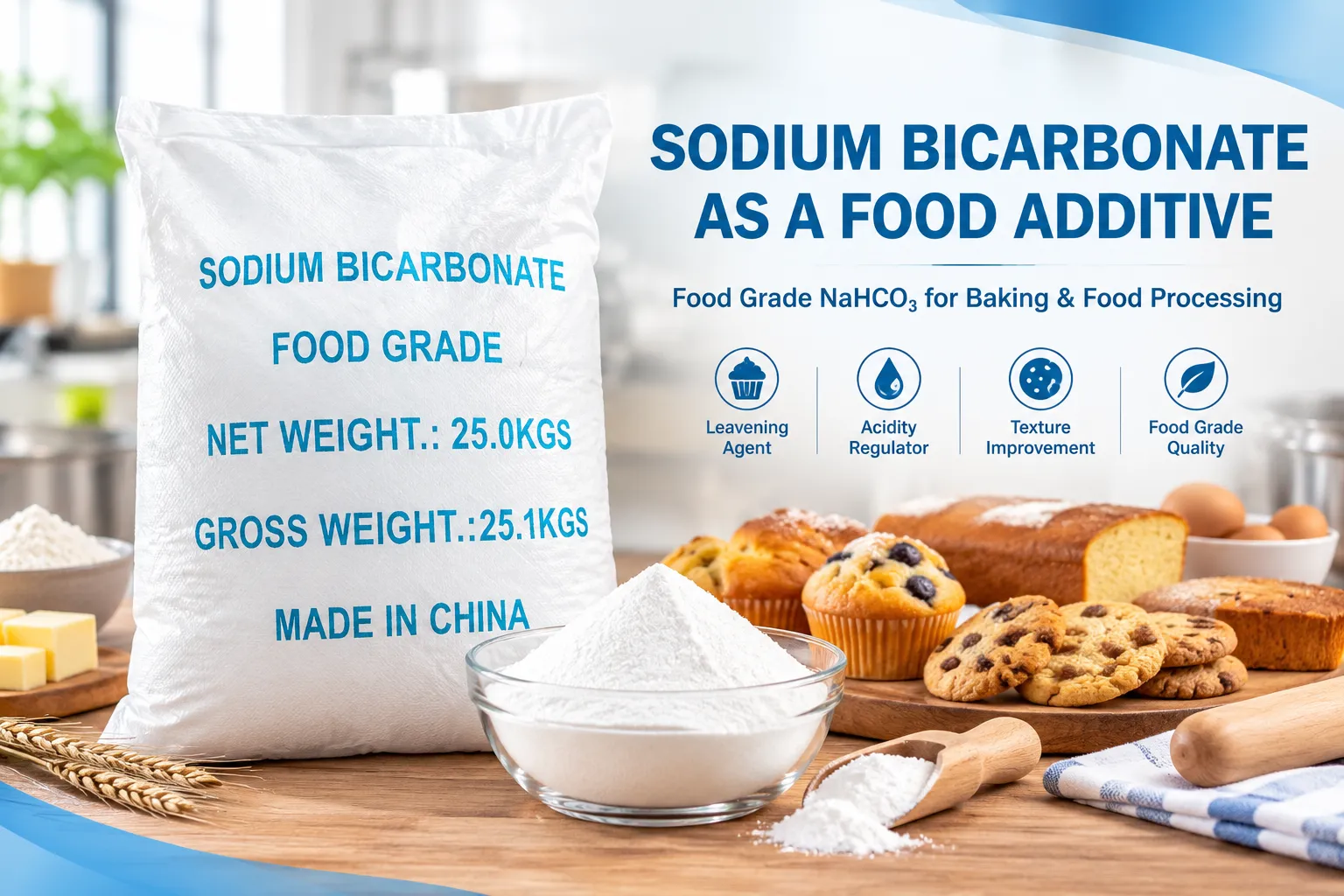
Sodium bicarbonate is widely used as a food additive in the food processing and baking industries. Also known as baking soda, it is an inorganic compound with the chemical formula NaHCO₃. It is commonly used as a leavening agent, acidity regulator, and processing ingredient in various food products.
Due to its ability to release carbon dioxide under suitable conditions, sodium bicarbonate helps improve the texture, volume, and overall quality of baked goods. Its versatile properties make it an important ingredient for commercial bakeries, food manufacturers, and other food processing businesses.
In this article, we will explore how sodium bicarbonate is used as a food additive, its main applications, and the factors to consider when selecting a suitable product for food manufacturing.
1. What Is Sodium Bicarbonate?
Sodium bicarbonate (NaHCO₃) is a white crystalline powder that is odorless and soluble in water. It is also known as sodium hydrogen carbonate or baking soda.
In the food industry, sodium bicarbonate is valued for its leavening properties and ability to help regulate acidity. When it reacts with an acid or is exposed to sufficient heat, it can release carbon dioxide gas. This gas forms bubbles within dough or batter, helping baked products rise and develop a lighter texture.
Food-grade sodium bicarbonate is manufactured and handled according to applicable food safety and quality requirements. It is important to distinguish food-grade material from industrial-grade sodium bicarbonate, as their intended applications and quality specifications may differ.
2. Why Is Sodium Bicarbonate Used as a Food Additive?
Sodium bicarbonate performs several functions in food production.
2.1 Leavening Agent
One of the most common uses of sodium bicarbonate is as a leavening agent in baked goods.
When sodium bicarbonate reacts with an acidic ingredient, such as buttermilk, yogurt, or certain food acids, it releases carbon dioxide. The gas expands during mixing and baking, helping the dough or batter rise.
This process is commonly used in the production of:
- Cakes and cupcakes
- Cookies and biscuits
- Muffins and pancakes
- Quick breads
- Other baked products formulated with suitable acidic ingredients
The correct dosage is essential. Too little sodium bicarbonate may result in insufficient rising, while excessive amounts can affect the flavor, color, and pH of the finished product.
2.2 Acidity Regulator
Sodium bicarbonate can help adjust the acidity of food formulations. As a mild alkaline compound, it can neutralize acids and influence the pH of a product.
This function is useful in selected food processing applications where acidity needs to be controlled for taste, texture, or processing performance.
The appropriate amount depends on the food formulation, the acidity of other ingredients, and the required final pH.
2.3 Texture Improvement
In certain food products, sodium bicarbonate helps create a lighter and more porous structure by releasing carbon dioxide during processing.
For example, it can contribute to the crispness of cookies and crackers and the soft, airy texture of cakes and muffins when used as part of a properly balanced formulation.
Its effect depends on the recipe, mixing conditions, baking temperature, and interaction with other ingredients.
2.4 Flavor and Color Development
Sodium bicarbonate can influence browning and flavor development during baking by changing the pH of the dough or batter.
However, the quantity must be carefully controlled. Excessive sodium bicarbonate may produce an undesirable alkaline or soapy taste and may cause unwanted color changes.
Food manufacturers therefore need to balance its functional benefits with the specific requirements of each product.
3. Common Food Applications of Sodium Bicarbonate
Food-grade sodium bicarbonate is used in a wide range of food manufacturing processes.
Baking Industry
Baking is one of the largest application areas for sodium bicarbonate. It is commonly included in formulations for cookies, cakes, biscuits, muffins, and other baked goods.
In commercial baking, consistent particle characteristics and reliable product specifications help manufacturers maintain stable production processes and finished-product quality.
Biscuit and Cookie Production
Sodium bicarbonate is used in many biscuit and cookie formulations to support expansion, texture development, and browning.
The dosage varies according to the recipe, desired product structure, and presence of acidic ingredients.
Snack Food Processing
Selected snack products use sodium bicarbonate to help achieve specific texture or processing characteristics. Its role depends on the product formulation and manufacturing method.
Food Ingredient Blends
Sodium bicarbonate is also used in some baking powder formulations and other dry ingredient blends.
In baking powder, it serves as the alkaline component and reacts with one or more food-grade acids to release carbon dioxide when moisture and, depending on the formulation, heat are present.
The balance between the alkaline and acidic components is important for achieving the desired leavening performance.
4. How Does Sodium Bicarbonate Work in Food Processing?
The functionality of sodium bicarbonate is closely related to its chemical properties.
When sodium bicarbonate reacts with an acid, it produces carbon dioxide, water, and a corresponding salt. The carbon dioxide becomes trapped in the dough or batter, creating bubbles that expand during baking.
A simplified reaction with hydrochloric acid can be represented as:
NaHCO₃ + HCl → NaCl + H₂O + CO₂↑
In food formulations, the acid may instead be an ingredient such as citric acid, lactic acid, or another suitable food acid.
Sodium bicarbonate can also decompose when heated sufficiently:
2NaHCO₃ → Na₂CO₃ + H₂O + CO₂↑
The actual behavior in a food product depends on the temperature, moisture level, formulation, and processing conditions.
Understanding these reactions helps food manufacturers select appropriate ingredient combinations and determine the correct dosage for their products.
5. Food-Grade Sodium Bicarbonate vs. Industrial-Grade Sodium Bicarbonate
When purchasing sodium bicarbonate for food manufacturing, buyers should select a product specifically intended for food use.
Although food-grade and industrial-grade sodium bicarbonate share the same chemical formula, they may differ in applicable specifications, quality controls, documentation, and suitability for particular applications.
Important factors to evaluate include:
- Purity: Confirm that the product meets the required food-grade specification.
- Moisture content: Check whether the product meets the requirements for storage, handling, and blending.
- Particle size: Ensure that the particle characteristics are suitable for the intended production process.
- Heavy metals and impurities: Review applicable limits and supporting test documentation.
- Food safety compliance: Verify the relevant regulatory requirements for the destination market.
- Certificate of Analysis (COA): Request batch-specific test results before shipment or use.
Food-grade status should be supported by appropriate documentation rather than assumed from the chemical name alone.
6. How to Choose the Right Sodium Bicarbonate for Food Manufacturing
Selecting a suitable sodium bicarbonate product involves more than comparing prices. Food manufacturers and importers should consider the following factors.
Confirm the Intended Application
Specify whether the product will be used for bakery products, biscuits, baking powder, or another food processing application. Different applications may require different particle characteristics or quality parameters.
Review Technical Specifications
Check the supplier’s technical data sheet and COA. Relevant parameters may include assay, moisture content, pH, particle size, and applicable impurity limits.
The exact requirements should follow the applicable food-grade standard and the buyer’s product specifications.
Check Packaging Requirements
Common industrial packaging options include 25 kg bags, with packaging details depending on the supplier and order requirements. Food-contact packaging suitability, moisture protection, labeling, and storage conditions should be confirmed before ordering.
Verify Export Documentation
For international purchases, buyers should confirm the documentation required by the importing country. Depending on the market and transaction, this may include a COA, Safety Data Sheet (SDS), specification sheet, origin documentation, and applicable food safety or conformity documents.
Regulatory requirements vary by destination and intended use, so importers should verify them before placing an order.
7. Storage and Handling of Food-Grade Sodium Bicarbonate
Proper storage helps maintain the product’s quality during transportation and warehousing.
Sodium bicarbonate should generally be stored in a cool, dry, well-ventilated area, away from excessive moisture and incompatible materials. Keep packaging sealed when not in use and follow the supplier’s instructions for storage and handling.
Food-grade products should also be protected from contamination during transportation, warehousing, and production. Manufacturers should follow appropriate hygiene practices and applicable food safety procedures.
8. Frequently Asked Questions
Is sodium bicarbonate safe as a food additive?
Sodium bicarbonate is permitted for specified food uses in many jurisdictions when it meets applicable requirements and is used under the relevant conditions. Manufacturers should verify local regulations, permitted applications, and use levels for their target markets.
Is baking soda the same as sodium bicarbonate?
Yes. Baking soda is the common name for sodium bicarbonate (NaHCO₃). However, a product intended for food use should meet the appropriate food-grade requirements.
What is the main function of sodium bicarbonate in baking?
Its primary function is to release carbon dioxide under suitable conditions, helping dough and batter rise. It can also influence acidity, texture, and browning.
Can industrial-grade sodium bicarbonate be used in food production?
Industrial-grade material should not be used in food production unless its suitability and compliance with all applicable food requirements have been formally established. Buyers should purchase products specifically qualified for food use.
How should food-grade sodium bicarbonate be stored?
Store it in sealed packaging in a cool, dry place and protect it from moisture and contamination. Follow the supplier’s handling instructions and applicable food safety procedures.
9. Conclusion
Sodium bicarbonate is an important food additive used in baking, biscuit production, and selected food processing applications. Its ability to release carbon dioxide, regulate acidity, and influence texture makes it a versatile ingredient for food manufacturers.
For commercial production, selecting the correct food-grade specification is essential. Buyers should evaluate purity, relevant impurity limits, particle characteristics, packaging, documentation, and compliance with the regulations of the destination market.
Working with a supplier that can provide consistent specifications and batch-specific documentation helps food manufacturers manage raw material quality and maintain stable production processes.
If you are sourcing food-grade sodium bicarbonate for your business, contact our team to discuss your required specifications, packaging, and export requirements.