
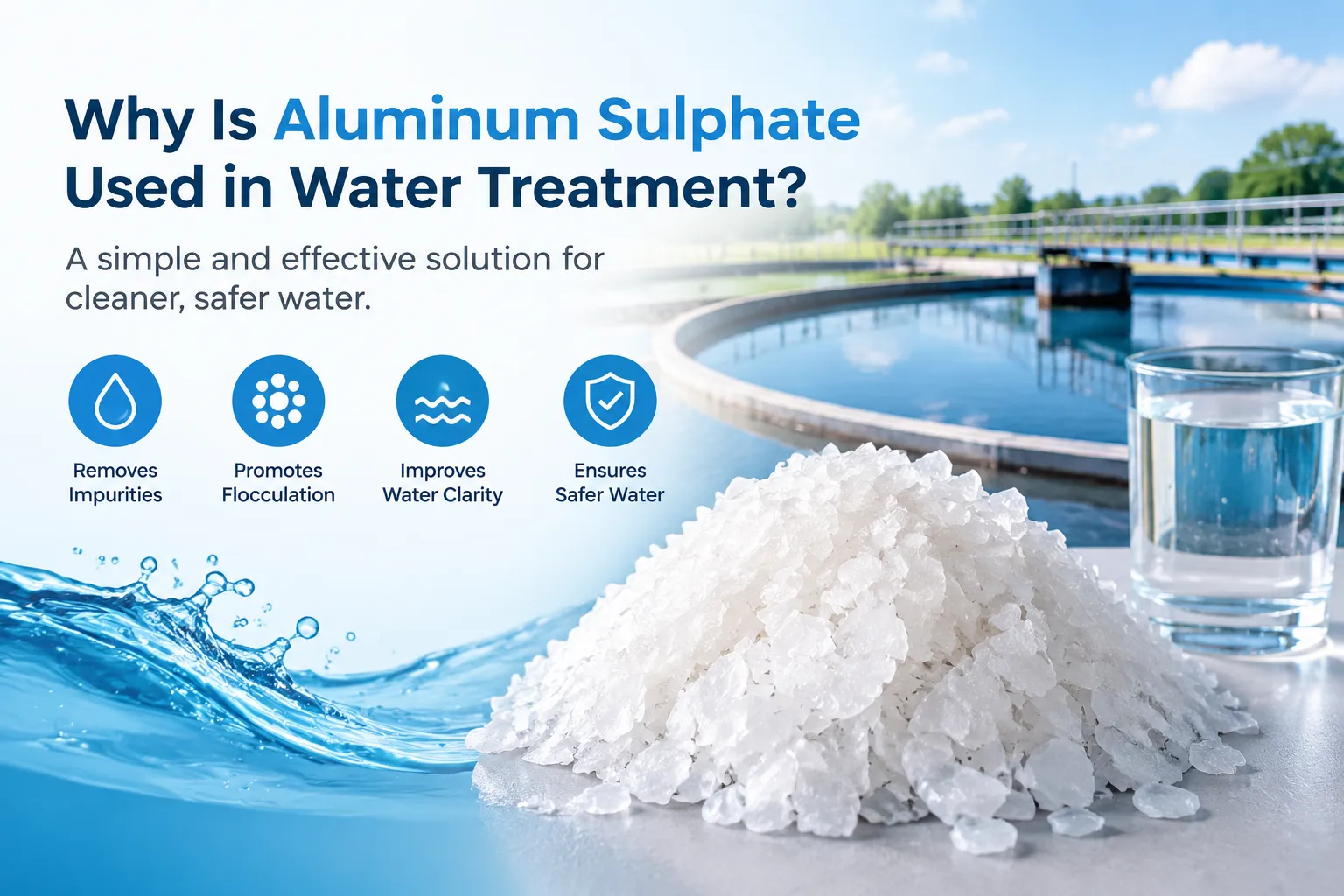
Clean water is essential for homes, businesses, agriculture, and industry. Before water can be supplied for drinking or reused safely, it often needs to be treated to remove dirt, suspended particles, organic matter, and other impurities. One of the most widely used chemicals in this process is aluminum sulphate, also known as alum.
Aluminum sulphate is commonly used in water treatment as a coagulant. Its main role is to help tiny particles in water clump together so they can be removed more easily through sedimentation and filtration.
What Is Aluminum Sulphate?
Aluminum sulphate is an inorganic chemical compound with the formula Al₂(SO₄)₃. It is typically supplied as a white or off-white powder, granules, or liquid solution. When dissolved in water, it reacts to form aluminum hydroxide compounds that are highly effective at capturing suspended impurities.
Because it is cost-effective, widely available, and suitable for established treatment systems, aluminum sulphate has been used for decades in municipal and industrial water treatment.
How Does Aluminum Sulphate Work in Water Treatment?
Many impurities in untreated water are extremely small. These particles may include clay, silt, organic matter, algae, and microorganisms. They often carry electrical charges that keep them separated and suspended in the water.
When aluminum sulphate is added, it begins a process known as coagulation.
The chemical reaction creates positively charged aluminum species that neutralize the electrical charges on suspended particles. Once the particles lose their ability to repel each other, they can collide and form larger clumps called flocs.
These flocs are then removed through:
- Sedimentation, where they settle to the bottom of a treatment tank
- Filtration, where they are trapped in filter media
- Flotation, where they are carried to the surface for removal in some treatment systems
In simple terms, aluminum sulphate turns hard-to-remove microscopic particles into larger particles that can be separated from the water.
Key Benefits of Aluminum Sulphate
Aluminum sulphate remains popular because it offers several practical benefits:
- Reduces turbidity and makes water clearer
- Helps remove suspended solids and fine particles
- Can reduce colour caused by natural organic matter
- Improves the efficiency of downstream filtration
- Supports the removal of some microorganisms along with the floc
- Works well in many conventional treatment plants
- Is generally economical compared with some alternatives
It is particularly useful when treating surface water from rivers, lakes, and reservoirs, where turbidity can increase after heavy rainfall.
The Importance of pH Control
The performance of aluminum sulphate depends strongly on the pH and alkalinity of the water. When it reacts in water, it can lower pH, which may reduce coagulation performance if the water becomes too acidic.
For this reason, operators may add alkaline chemicals such as lime or sodium hydroxide to maintain suitable treatment conditions. The ideal dosage and pH range depend on the source water, temperature, turbidity level, and treatment objectives.
Jar testing is commonly used to determine the most effective aluminum sulphate dose before full-scale treatment.
Aluminum Sulphate in Drinking Water Treatment
In drinking water treatment plants, aluminum sulphate is used before filtration and disinfection. By removing suspended particles early in the process, it helps improve the appearance and quality of the water entering later treatment stages.
However, the use of aluminum sulphate must be carefully controlled. Water treatment facilities monitor finished water to ensure it meets applicable drinking water regulations, including requirements for residual aluminum where relevant.
Proper dosing, mixing, settling, filtration, and monitoring are all important for producing safe, high-quality water.
Aluminum Sulphate vs. Other Coagulants
Aluminum sulphate is not the only coagulant used in water treatment. Other common options include polyaluminum chloride (PAC), ferric chloride, and ferric sulphate.
The best choice depends on the water source and operating conditions. PAC may perform well across a broader pH range in some applications, while iron-based coagulants can be effective for particular contaminants or wastewater streams. Aluminum sulphate remains a dependable option where conventional treatment processes and source-water conditions support its use.
Conclusion
Aluminum sulphate is used in water treatment because it is an effective coagulant. It helps remove turbidity, suspended solids, colour, and other fine impurities by causing them to form larger flocs that can be settled or filtered out.
When applied at the correct dosage and pH, aluminum sulphate can play an important role in producing clearer, cleaner water. For the best results, treatment plants should base chemical selection and dosage on water-quality testing and local regulatory requirements.